The City of Albuquerque's casita guide includes a diagram of a sample lot. The side and rear yards add up to 4,009 square feet. A quarter of that is 1,002 square feet, so the example fits a full 750-square-foot casita with room to spare.
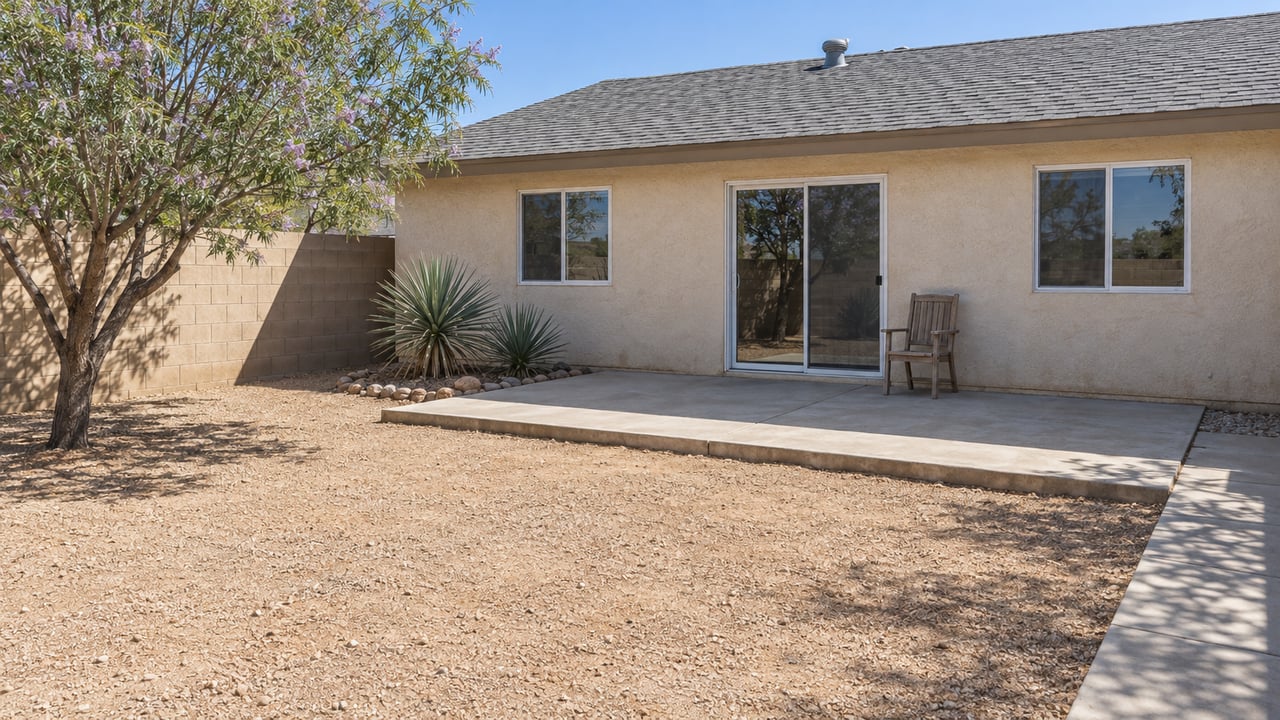
That example lot is generous. The casita you can actually add depends on what the house leaves behind it. If you're touring homes because you want space for a parent, an adult child or a future rental, measure that leftover yard before you settle on any number.
The 25% rule usually sets the size before the 750 cap does
Inside city limits, the rules for a detached casita are short. It can be no larger than 750 square feet. It can't cover more than 25% of the side and rear yards combined. It can't be taller than the main house. It has to sit behind the rear wall of the house, at least 5 feet from the side or rear lot line.
Run the 25% rule backward and you get the number that matters when you shop. A lot needs at least 3,000 square feet of combined side and rear yard before the 750-square-foot cap even applies. Below that, the yard sets your ceiling.
| Combined side and rear yard | 25% of that yard | Largest casita under the standard citywide limits |
|---|---|---|
| 2,000 sq. ft. | 500 sq. ft. | 500 sq. ft. |
| 2,400 sq. ft. | 600 sq. ft. | 600 sq. ft. |
| 3,000 sq. ft. | 750 sq. ft. | 750 sq. ft. |
| 4,009 sq. ft., the city's diagram | 1,002 sq. ft. | 750 sq. ft. |
The table is simple arithmetic on the city's 25% rule and 750-square-foot cap. It doesn't account for the neighborhood limits covered below. On a tight tract lot, a bigger house can mean a smaller casita, because every extra foot of house comes out of the yard the formula uses.
A few other rules shrink the usable space further:
- Height. The casita can't be taller than the main house, so a single-story home means a single-story casita.
- Separation. The building code requires 5 feet between buildings unless the casita is fire rated. That's on top of the 5-foot zoning setback from the rear or side lot line.
- Access. A casita can run the full width of the rear yard, but a passage at least 5 feet wide has to stay open somewhere.
- Parking and color. You need one off-street parking space, and the casita's exterior color has to match or closely resemble the main house.
- Corner lots. The casita has to keep the same street-side setback as the main house.
Two neighborhoods have their own limits. In the Downtown Neighborhood Area, known as CPO-3, a casita is capped at 650 square feet and at the height of the main house or 18 feet, whichever is less. In Sawmill and Wells Park, CPO-12, R-1 lots have a minimum lot size of 7,000 square feet.
In February 2026, the city kept the detached casita as the only extra unit on R-1 lots
All of that yard math carries more weight because of a vote this year. On February 18, 2026, the City Council took up the biennial update to the Integrated Development Ordinance, Albuquerque's zoning code, as bill O-26-2. Floor amendments would have added three options in R-1 zones. Duplexes, townhouses and attached accessory units all failed, according to the city's IDO update tracker.
The Albuquerque Journal reported that Councilor Tammy Fiebelkorn sponsored the housing amendments. Of the 16 amendments offered, nearly all failed 5–4. The Journal listed Renée Grout, Dan Champine, Dan Lewis, Brook Bassan and Council President Klarissa Peña as voting against them, and Stephanie Telles, Nichole Rogers, Joaquín Baca and Fiebelkorn as voting for them. Supporters argued for more housing supply and lower costs. Opponents raised concerns about neighborhood change and about developers favoring luxury housing. KOAT separately reported a 5–4 vote against letting homeowners convert single-family homes to multifamily housing without a variance.
The update itself passed 6–3, as reported by the Greater Albuquerque Association of Realtors. City records show the bill went to the mayor on February 25 and was not signed. It was enacted March 11 with an effective date of April 20, 2026. The city's IDO page says applications submitted on or after May 6, 2026 are reviewed against the updated document. It also says each application is reviewed under the rules in effect on the date it's accepted as complete.
For a buyer, the result is simple. On a city R-1 lot, the extra unit you can add is the detached casita that has been allowed citywide since 2023, under the same 750-square-foot and 25% limits. One more amendment, O-26-61, takes effect November 4, 2026. It removes references to Coalitions of Neighborhood Associations and doesn't touch the casita standards.
Lots in unincorporated Bernalillo County use a different formula
Some North Valley and South Valley homes have Albuquerque mailing addresses but sit in unincorporated Bernalillo County. The county writes its own zoning rules, and its limit is based on the size of the house rather than the yard.
The county calls a casita a secondary dwelling unit, or SDU. Its multi-generational housing brochure, updated April 2025, sets these terms:
- An SDU can be up to 1,000 square feet or 50% of the main house's size, whichever is smaller.
- It generally has to be at least 10 feet from other structures, and the lot size sets how far from the main house it can be.
- An SDU that meets the rules is a permissive use, which means it's allowed by right. You still need a building permit.
- Exceptions, such as a lot below the minimum size or setbacks that can't be met, require a conditional use. That process includes public notice and a hearing.
So the math changes at the city line. Under the county formula, a 1,400-square-foot house supports a casita of up to 700 square feet. A 2,000-square-foot house reaches the full 1,000. Under the city formula, those same houses could be capped at 500 square feet by a small yard. The county's January 2025 announcement described the SDU rules for A-1, A-2 and R-1 zoning. The brochure lists A-1, A-2, R-1, R-2 and M-H as the zones for its multi-generational housing options in general. The county also allows a detached "accessory living quarters" with a bathroom but no kitchen. It can't be rented to a separate household. The county's Homeowner Projects & Permits page is where to start for a county parcel.
The city process includes a step many buyers don't expect
Even when the yard math works, a city casita goes through two approvals, and the first one involves your neighbors. The city's guide lays out the order:
- Prepare a site plan showing the property lines, any easements, every existing structure, the new casita and its parking space. You'll also need an updated grading and drainage plan, plus stamped truss drawings if they're required.
- Post a sign on the property and email the affected neighborhood association, then file an administrative site plan through ABQ-PLAN.
- Apply for a building permit and pay the fees. Electrical, plumbing and mechanical work each need their own trade permits.
- Respond to any corrections, then print the approved plans and keep a set on site for inspections.
For walk-in help, the Building Safety counter is in suite 190 of the Plaza Del Sol Building at 600 2nd St. NW.
The city can lower your design costs. In December 2023, it set a goal of encouraging 1,000 casitas by 2025 and released free plan sets. Today there are four free casita plans, from 450 to 750 square feet, donated by Nieto Custom Builders and Ron Montoya Designs, and some are 3D-printable. Pick the plan after you measure the yard. On a lot with 2,000 square feet of side and rear yard, the 750-square-foot plan won't fit.
FAQ
How do I tell whether a home is in the city or the county? Enter the address in the city's zone look-up map. In the city, casitas are allowed in R-A, R-1, R-T and R-ML zones. If the parcel isn't under city zoning, check with Bernalillo County Planning.
Can I attach the casita to the house instead? The city's casita guide describes casitas as detached buildings, and the floor amendment that would have allowed attached accessory units in R-1 failed in February 2026. Planning staff can confirm what applies to a specific lot. The county's brochure lists a second kitchen inside the main house, connected by enclosed space, as a separate option.
Can a city lot have more than one casita? In R-A and R-1 zones, the limit is one casita per lot.
This post is general information, not legal or financial advice. Before you count on a casita in your plans, confirm the rules for your specific parcel with city or county planning staff and the right professionals.
If a casita is part of why you're shopping, let's measure the yards on your shortlist and check which side of the city line each home falls on before you make an offer. Carrie Telles can walk the lots with you and help you see which ones fit the casita you have in mind. Schedule a free consultation.